Showing posts with label Maasai. Show all posts

Wednesday, March 28, 2012

Improving the Odds for Success Through Enriched Education Opportunities Like TEC

You might be able to imagine that getting an education in Tanzania could be a challenge. If you are a girl and if your family has little income, the challenge increases. If you belong to the Maasai tribe, it increases yet again. If you live in a rural area, triple the challenge. As a Canadian-born and educated woman, I can say that those of us living in this part of the world really have no idea what girls and women in Africa go through daily to realize their dreams of being educated.
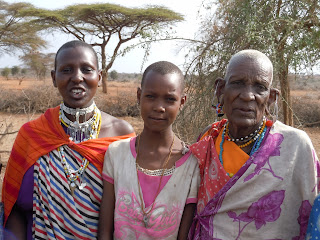
Education opportunities have changed greatly for these three generations - mother, daughter, grandmother.
Developing countries are doing what the name says - developing. When I visit Tanzania it feels like systems and structures are about 50 years behind what we enjoy in the western world. There are many examples but I am thinking of things like health care, transportation and roads, and education. We can "see" inside so much of the world today thanks to wonders like the internet and smart phones and cable television. Watching news coverage of stories in places like Africa do you sometimes find yourself asking, how can people live like that? or why don't they change? or what's wrong with them?

Well, there is nothing wrong with Africans. They are developing and changing just as other countries have. They are facing enormous challenges and can use all the help they can get from those of us who have progressed through the development phases before them.
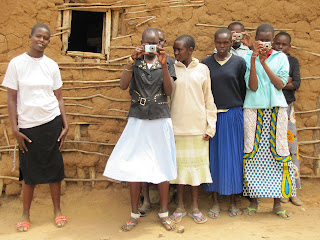
These girls thrive when given the opportunities for enriched education Canadian girls have. 
Receiving education is crucial to development and, while any education has the potential to open future possibilities for us, good quality education that provides both learning and confidence makes the greatest difference. Looking at the report cards of many students in Tanzania, some might be prompted to ask, what's wrong with these students? or why aren't they succeeding? We might falsely conclude that Tanzanians are not as smart as we are. Nothing could be farther from the truth.

The girls TEMBO sponsors are just like Canadian girls in secondary school. Except for a few differences: they live in rural villages in a country that is still developing, including the education system and teacher preparation; most of their families are economically very poor and secondary school is not free; they belong to the Maasai tribe where formal education has not been part of the culture and, if a family can send a child to school it is usually a boy; there are very few syllabus books for students to share; and all subjects taught in secondary school are taught in English - a third language the students have had very little exposure to - after speaking the Maa language at home and Swahili in primary school. I could go on about the hurdles Tanzanian girls have to face but I think you get the picture.
Mary Laiser does all the on the ground preparations in Tanzania for TEC.
Four years ago I was having a conversation during a project visit with Mary Laiser, one of the TEMBO staff  very involved in the education program. We were concerned about the failing grades of many of the girls and wanted to do something to help them succeed. We decided to offer the girls a chance to receive tutoring during their one month break in June. Mary made arrangements for the girls to be accommodated in Longido and be instructed by one of the teachers. The first week went well then the girls began skipping classes and failing the tests. We ended the program after the second week. The program was not what they needed and too much like what they got during the school year. The girls went back to school after the break and little changed.

I talked with Marian Roks, one of the TEMBO co-founders, and a life long teacher. I knew Marian had coordinated summer camps for many years for deaf students in Ottawa. These camps were both rich learning opportunities and enjoyable experiences her students looked forward to each year. Could something like this ever work in Tanzania? Why not, we concluded, since students are the same everywhere.
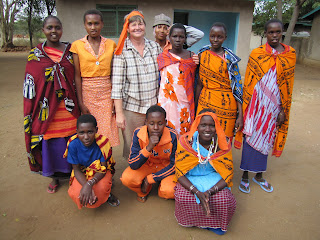
Marian Roks and some of the girls dressed in orange to celebrate
the Netherlands success in the 2010 Fifa  World Cup.
You need to know about TEC - the TEMBO English Camp - developed by Marian and Virginia Taylor. Virginia is on the Project TEMBO Board of Directors in Canada and she is also an instructor in the ESL Teacher Training Program at Carleton University in Ottawa. TEC takes place for three weeks in June, half a world away, and I am sure that, if you listen closely, you can hear and feel the joy it exudes right across the Atlantic Ocean. It's a program delivered entirely in English that we believe is really making a difference for the girls TEMBO sponsors. It's part formal instruction shaped around the girls' school curriculum; part informal instruction through activities like the camera club, or cooking, or sports and games; and a whole lot of fun that takes place through interactions and conversations with Marian, Virginia, and the growing number of Canadian volunteers taking part in TEC.
Virginia Taylor with two of the proud TEC graduates in 2010, the inaugural year.
Recently, Marian, Virginia, and I met for coffee at Bridgehead Coffee House in Ottawa to talk about the June 2012 TEC program. The lesson planning has been well under way for a number of weeks with Canadian teachers and volunteers both in university and older. We talked about exciting new ideas to incorporate into the evolving TEC program, including important suggestions from Mary and Paulina in Tanzania. This year student teachers from Mt Meru University and in Teacher Training programs will be involved. It's part of the vision TEMBO has of making this education support program sustainable. Another addition will be including 15 students from Kimokouwa and Longido Primary Schools in a "Pre-TEC" program. This will allow TEMBO to help students become comfortable at reading and speaking English before they get to secondary school.

TEC has grown to the point that it would not be possible without the involvement of so many in Canada and the time, skills, and coordination of Mary Laiser and other TEMBO staff in Tanzania. This year we are especially grateful to the Ontario Teachers' Federation for a $5000.00 donation for TEC program expenses.

The education system in Tanzania is developing. Many feel it is not happening quickly enough. In February students at Ketumbeine Secondary School - where some of TEMBO's sponsored girls attend - "rioted" in protest of the poor quality teaching they were receiving. They publicly drew attention to an important reality: it is very difficult for rural schools in Tanzania to attract well trained teachers. This is not to say there are not good teachers in the countryside - it's just that there are very few of them.

All of us believe that the girls TEMBO sponsors can and will do better academically with help we can provide. We've got a lot to share thanks to the abundant and varied education opportunities we've had. And if some girls in Tanzania can gain confidence - through an enjoyable enriched learning program - that will help them do better in the classroom, then the time and effort running the TEC program is a very good investment.

Thursday, March 15, 2012

Worlds Apart and Worlds Together

Paulina and Kokoyai in Kimokouwa.
The other day I came across this photo of Paulina, TEMBO Trust Project Coordinator, and Kokoyai, a young mother living in Kimokouwa I have known since she was 10 years old. The photo is a couple of years old - Paulina, who usually wears Western-style clothing, now has her head shaved, like Kokoyai. At a glance it's a photo of two young traditional Maasai women. If you've visited the TEMBO project area you know these women live very different lives - actually "worlds apart." Still, both play a very important part in the telling of the story of TEMBO and the work we do. I find myself thinking how these two women live "worlds together," too, each telling an important part of a larger story. It's a story about evolution, modernity, and the oh so fragile balancing act of moving forward in a world changing at lightening speed while still being true to a cultural heritage filled with richness and beauty. How will they keep it all together?

In Kimokouwa, Kokoyai is part of the Maasai people who choose to live a very traditional lifestyle. Though they cannot follow the rains to graze large herds of cattle like they once did, due to government laws restricting their movement, the people still live in mud huts, eat a simple diet, dress in colourful shukas, and observe tribal norms and customs. Kokoyai attended Kimokouwa Primary School, as mandated by the government, and she and her father opted for Kokoyai to marry when she finished Standard Seven rather than continue her education. She and her husband, Philipo, currently have two boys. According to custom, Philipo is free to have as many wives as he wants. Kokoyai  also belongs to the KWGP (Kimokouwa Women's Goat Project), coordinated by TEMBO Trust.

The power stick carried by men, now with the pen representing education.
Paulina grew up in a Maasai boma near Mt. Kilimanjaro where observing traditional customs and practices was very important for her father, too. He wanted Paulina to marry after primary school. Paulina wanted desperately to continue her education. With the help of her mother, her brother, and others Paulina succeeded in completing secondary school and earned a full scholarship to the University of Dar es Salaam. Paulina's father attended her graduation ceremony and gave her a pen and a notebook as a gift, symbolizing his wish for her to continue to study, if it was her wish. He had come a long way and was embracing change.

Over the years, I have observed striking images expressing the reality that the Maasai are struggling to hold two realities, two worlds together. The world of the 21st century is knocking at the door of the Maasai in Tanzania. It is a tenuous time filled with tremendous possibilities and wrought with danger too. There is a lot at stake. As in any culture, some practices of old need to be discontinued and left behind in order for people to move forward. Women like Paulina, because of the education they have received, have a pivotal role to play in reshaping the new world of the Maasai. Knowing how to change, what to let go of and what to keep, is best done  from within by those who understand and cherish the world of the Maasai. These strong voices must be heard over the noise and values of other societies that threaten to consume and assimilate them as they have done to other tribes and other peoples throughout time.

Receiving a cell phone message: Kokoyai's father, Paulo, is in his 80's and embracing change. 
Kokoyai and the Maasai of Kimokouwa and Longido, and throughout Tanzania, have a right to a traditional life if they so choose. Paulina, and many other educated women and men like her, are using their skills to help keep everything in balance: saying thoughtfully to the Maasai 'yes' keep this, it is good, and 'no' this practice is harmful and outdated and it must go; and to those outside who would exploit or deceive the Maasai they say 'these are our rights by law, our education has taught us so.' Those of us fortunate enough to have been allowed to play a part in this unfolding must only play a supporting role, actively enabling women like Paulina and Kokoyai to take center stage.

Thursday, March 1, 2012

Early Pregnancy and Education


The new school year began early in January and TEMBO Trust staff successfully enrolled 18 new girls in Secondary School. If I close my eyes it is so easy to see their faces even though I was not in Tanzania when they were selected. Physically the girls are very small, in so many ways still children with their whole lives ahead of them. Since they passed the mandatory Standard Seven Leaving Exam at the end of Primary School, and have qualified to receive sponsorship by TEMBO, the girls now have the opportunity to continue their education. The challenges they will face on this new journey are going to be enormous and the girls deserve all the help we can give them.
Some of the TEMBO sponsored girls.
One of the greatest challenges they will face is avoiding early pregnancy. In Tanzania, if a girl becomes pregnant she will not be admitted to Secondary School. It's an old law that many, both within and outside the education system are trying to change, including TEMBO Trust staff and trustees. To understand the difficulty the girls face you need to understand African culture and, in particular, the Maasai culture. Among the Maasai, sexual activity at a young age is seen to be normal and even welcome. This is especially so in families where parents have received little or no education.

Most of the girls TEMBO sponsors belong to the Maasai tribe that populates the northern part of the country including Longido and Kimokouwa. Like many other African tribes, the Maasai depend upon extended families to sustain their lifestyles. There is a lot of hard work to do. Multiple wives with many children and large cattle herds has been typical until recently. The new reality of continual drought is prompting many Maasai to now switch to herding goats. Nonetheless, the children participate in caring for the animals. While the young boys are with the herds the young girls are helping run the households – walking long distances each day to fetch firewood and water, caring for the young, cooking and keeping the boma tidy. Add in the reality of early death - often in the mid 40's - and it's clear that large families are a way of ensuring there is always a ready workforce.

There is an alternative to girls simply following in the footsteps of their mothers and remaining traditional Maasai. It is formal education. In fact, many women want their daughters to be educated and have lives different than theirs. More and more, Maasai men are allowing their daughters to attend secondary school. Common practice is if a girl receives sponsorship she will be allowed to go to school, and if a girl is in school she will not be given in marriage to a man. For the most part this works and girls are protected from early marriages – at least until they finish Form 4 or Grade 12. But not always.
Sponsorship includes providing everything for living at boarding school
At the beginning of January 2012, the new school year, three of the girls TEMBO has been sponsoring have been turned away from school because of pregnancy. The girls returned to their bomas to give birth. For most girls in this situation, the next step will be marriage to an older man in exchange for cattle given to the father of the girl. Guess what? These girls are not some small exception. Consider these statistics from the website The Elders:

  • Every day, it is estimated that more than 25,000 girls under the age of 18 are married. 
  • 100 million more girls – around 10 million each year – will become child brides over the next decade.
  •  In the developing world, one in three girls is married before she is 18; one in seven before she is 15.
  •  A girl under the age of 15 is five times more likely to die in childbirth than a woman in her twenties.
These numbers are staggering! They also have names and faces. If at all possible, TEMBO will look for a private school to send the girls to to continue their education. This will depend upon whether or not money is available since private school sponsorships are a much more expensive option. 
Girls are learning to speak for themselves.
There is hope for change and in the next post you will hear about small actions that are making a big difference.

Sunday, February 26, 2012

Stories About Remarkable People

In this blog space I want to share stories and photos about the colourful, hopeful, and resilient people I have met since first setting foot in Tanzania in July 1998. I want you to know about the world they live in including their challenges, hopes, and dreams, and how they overcome daily obstacles few of us would ever withstand. In particular, I want you to meet the girls and women TEMBO Trust sponsors in the Education and Micro-Business programs it runs in Longido and Kimokouwa, two villages in northern Tanzania. You will also meet the staff on the ground, the people who work day in and day out to improve life in the villages and to make TEMBO's vision a reality.

Some of the women in Kimokouwa. Mount Longido is in the background.

Longido girls fetching water after a busy day at school
Since 1998 I have made many project visits to Tanzania. I have taken thousands of photos that tell as many stories. Some I have shared in journal notes I have kept and written about in other blogs. Still, my collection of stories and of photos keeps on growing, right along with the town of Longido.

I hope you will feel free to add your comments and thoughts. You can enter your email address in the column on the right. This will ensure you are notified whenever a new entry is posted here.