Showing posts with label education. Show all posts

Friday, August 3, 2012

Be Inspired

Some TEMBO sponsored girls who attended TEC - TEMBO English Camp - in 2010.

Dear TEMBO Trust Secondary School Sponsored Girls -

I know many of you in places like Longido may not be aware that the Olympics are taking place in London right now due to a lack of electricity or TV. The athletes are doing some pretty amazing things and I wanted to share one of them with you today. It's about a 16 year old girl named Gabby Douglas.

Gabby's story is printed here in the New York Times. The important thing I want you to know is that this very young athlete has become the first African American woman to win an Olympic Gold Medal in Gymnastics. This was no small accomplishment and Gabby had to make many sacrifices to reach her goal. Most of all, she had to gain confidence and to believe in herself. She told herself during the competition, "Believe, don't fear, believe."
16 year old, Gabby Douglas: "Believe, don't fear, believe."
Gabby knows she is now an inspiration to so many young girls all over the world and I wanted you to be some of those girls. You may not want to be a gymnast, and you have dreams and goals of your own. The message here is simply BELIEVE IN YOURSELF and have confidence that you can overcome whatever obstacles you find on the path between you and your goal. For you this might be just staying in school, or saying 'no' to marrying young and having a child. Keep your focus on your goal to finish Secondary School, then take the next step to learn something after Secondary School. Then, the next step will be clear. You can do it.

Good luck as you continue Term II studies at different schools in Longido District. I will end with another question I found today - I think it's a good one, not just for you, but for people of all ages.

Friday, July 27, 2012

Shooting For the Moon

This past week some pretty significant things happened in the world. One of them was that Sally Ride died. Many people remember her as the first American woman to fly into space. Sally was this woman, and a lot more. When she flew into space in 1983, Sally became a symbol to many girls and young women that it was possible to move beyond cultural barriers and do things that had never been done before. That's so important.
Some of these girls from Longido and Kimokouwa
are enrolled in Vocational Training courses.
Thirty years later, courageous young girls all over the world are still asking for their rights to be met, including the right to education. In many cultures and for many years, girls have been told their lives would be devoted to building the family home, having children, fetching water and firewood each day, cooking, and cleaning. What if a girl wants to do something different? It isn't easy and the obstacles are huge.

Not everyone has the privilege of helping young girls mount near insurmountable odds in pursuit of their dreams. I am one woman who does, and I am just one of many people.
Astronaut, Sally Ride, was the first American woman to fly
outer space in 1983 - breaking through barriers to achieve her dream.
Last week 11 girls from Longido and Kimokouwa returned to Vocational Training courses and 13 new girls began new Vocational Training programs. Taking this step has the potential to dramatically change their lives. The girls - Rahema, Mary, Martha, Tabitha, Rachel, Ester, Nimfa, Sereya, Upendo, Margreth, and many others, are stepping over the confines of old restrictive barriers and into very strange and new worlds beyond the security of their Maasai bomas and traditions. They are enrolled in many different courses of study including: marketing, tailoring, community development, early childhood education, food preparation, tour guide, police officer, bookkeeping, medical assistant, and agricultural college training. The girls may not think they are doing anything special, but they are trailblazers and role models today, just as Sally Ride was in 1983. The choice they are making today means their daughters will grow up in a world that is very different from their world today.

These 24 girls are courageous for another reason, too. By continuing in school they are saying very clearly "I WILL NOT BE A CHILD BRIDE AND A CHILD MOTHER." They will not be added to the 51 million other girls throughout the world who are adolescent brides and mothers. That is an astounding number that is larger than the entire population of my country, Canada.

To these girls I say, "You are pretty special. You are change makers. You are a very big news story in the world this week."

Thursday, July 5, 2012

Against All Odds

Child marriages and early pregnancy spell the end of dreams.
This week 58 Secondary School girls being sponsored by TEMBO are preparing to return to school for Term II. Many have just finished a 2 week intensive English program called TEC - TEMBO English Camp - an experience in Longido that will better equip them to be successful in their studies. As many of you already know, this program, and Secondary School sponsorship, are generously funded by donations made to Project TEMBO in Canada.

I can picture the faces of so many of these girls. Compared to Canadian girls their age they are physically very small. Yet they teeter precariously on the edge of a very adult ritual they have, thus far, avoided - marriage. So many of their young friends, like millions of other girls around the world, have not been so lucky. This has prompted Time Magazine to recently ask the question, "Why is it so Hard to Combat Child Marriage?"

Joyce, from Kimokouwa, is currently at the 
University of Dar es Salam and stands as 
a role model for young girls.
 All girls TEMBO sponsors are not successful in navigating the minefield of child marriage and early pregnancy. I can tell you about Sara (not her real name) a Form 2 girl who attended TEC 2 years ago. Sara is from a very poor Maasai family and is young and full of dreams for life as an independent woman able to support herself economically. She could not attend TEC a year ago because she was pregnant and women in the village felt that allowing her to attend would be setting a bad precedent. Sara delivered a baby girl in October 2011. Still she enthusiastically wants to return to school and not get married to an older man. Sara knows only too well that marriage would spell the end of her dreams and relegate her to life as a woman with no voice.“[Child marriage] is one of the most stark examples of the devaluing of girls and of girls abilities beyond that of being wives and mothers,” says Margaret Hempel of the Ford Foundation. "The challenges faced by a female child bride are profound: the dwindling of opportunities for education, the loss of any hope for economic independence, the threat of infant mortality—the total narrowing of the girl’s life," the Time article continues.

The Ford Foundation has just released an interactive world map on child marriage and it is very telling and not surprising to those who have spent time in northern Tanzania. Tanzania is one of the 30 countries in the world with the highest rates of child marriages with almost 50% of girls married by age 18. Longido and Kimokouwa - where TEMBO works - are situated in one of two areas in Tanzania that have both the highest rates of child marriages and the lowest rates of education for girls. 

 The Ford Foundation believes that lasting solutions will come from those most directly affected. Those of us with resources can stand with mothers and daughters who want to change this practice.“Some of the most effective [solutions] are finding ways for girls themselves to be able to talk about the future that they want and be visible spokespeople for these changes in their own lives.” If you are supporting TEMBO you are actively engaged with us in doing this work through education sponsorships and the work of TEMBO staff, Paulina and Mary, in Tanzania. Sponsorship is crucial because it places girls in a safe school environment where child marriage is delayed. 
Mary and Paulina are powerful education advocates.
Mary and Paulina, two young Maasai women who understand the challenges, take it a step further by meeting regularly with the girls in school and talking about their "rights" and how to respond to unwanted advances by men. Girls who have had little experience outside of the confines of their family bomas don't know that life can be different for them then it has been for their mothers. Imagine the freedom and joy of  the sound of a girls own voice saying 'no' to centuries of ingrained behaviour. 

If the 58 girls about to begin Term 2 at Secondary School can withstand cultural pressures to be traditional Maasai women who marry early and have babies; and if they can stay in school instead, it will be thanks in large part to the partnership of donors to Project TEMBO in Canada with TEMBO Trust staff on the ground in Tanzania. Most of the credit, though, must go to the girls themselves for enduring in the face of such great odds against them.

Wednesday, April 25, 2012

Education That Opens Doors to the Future

Nusra in the TEMBO Guesthouse kitchen window.
If you've ever stayed at the TEMBO Guesthouse in Longido, Tanzania, one of the memories you leave with is the smiling face of Nusra. And you are smiling, too, because you've been able to taste her delicious cooking in the middle of a small dusty town far away from any western influence. For international travellers visiting Africa for the first time, Nusra makes the transition so easy by preparing sumptuous dishes like spaghetti and meat sauce, guacamole, Chinese stir-frys, chocolate cake, home made bread, French fries, and the best pizza in the world. Really!

Nusra baking fresh white buns over a home made outdoor charcoal oven
When I first met Nusra in 2008 she was working as a "house girl" for a woman in Longido. She spoke very little and spent her days cleaning, doing laundry, running errands in town, and preparing meals. Those of us from Canada who knew Nusra always had the feeling that she understood a lot more English than she was letting on. When she started reading books we brought from Canada it was clear that Nusra wanted to know more.

Nusra was like so many young women I have met in Tanzania. She had loads of ability but she lacked the money to develop that ability through training. One day I said "You don't always want to be a house girl, do you Nusra? What is your dream?" Nusra shyly replied that she wanted to be a cook. But, her parents were dead and her family could not afford the cost of further education. The 30,000 TSH, or roughly $20.00 US, she earned each month was easily used just meeting basic needs.

Nusra's story is the story of millions of young girls in Africa. Without sponsorship they have no hope of realizing their dreams or of significantly bettering their lives. They are doomed to live as poor women, marrying young and raising children, locked in the same downward spiral their mothers and grandmothers were trapped in. It doesn't have to be this way, and it shouldn't be this way.

For most secondary school students, 
Vocational Training is their key to future independence
Vocational Training opens doors. Most of the girls that TEMBO sponsors who will be leaving Form 4 Secondary School this year have already asked TEMBO to sponsor them for Vocational Training. They want to enroll in a variety of programs: pre-school teacher training, tailoring, hotel management, agricultural studies, nursing, and military training. They will join young women currently enrolled in community development, tourism, police training, and other programs. When they graduate they will have the necessary skills to support themselves. Some will be supporting children, too, since child-mothers who must leave Secondary School also want to continue their education. Because they cannot return to the government school system Vocational Training is a wise choice.

Nusra at the Sinon College graduation ceremony, with Namaluk.
TEMBO was able to offer Nusra sponsorship at The Sinon College in Arusha where she studied Food Preparation. She graduated at the top of her class - no surprise to any of us - we knew she was very talented and hard working. As it happens, Nusra's graduation occurred just as the TEMBO Guesthouse was opening in January 2009. We needed a trained chef and Nusra needed a job. It was a win-win situation. Nusra has continued to develop her skills. Her pizza is famous throughout Longido - just ask any international NGO worker who spends time in town. Did I mention that the TGH does not have electricity or an oven? So how can Nusra cook pizza, you might wonder? You will have to visit Longido to find out her secret. You won't be sorry you did.

My dream is that one day TEMBO will be able to fund all requests we receive for Vocational Training. Every young woman deserves a chance to learn a skill that will enable her to be self supporting and live an independent life. Young women like Nusra stand as shining lights to girls in the community. What they are able to give back in exceptional service makes the initial investment in sponsorship so worthwhile.

Wednesday, April 18, 2012

The Dreams of Mothers and Grandmothers

I remember asking a young girl in Tanzania once who in her life had been an inspiration to her. Who was her model or her ‘hero?’ She told me it was her mother. It’s not that she didn’t know about Rock Stars or Movie Stars. Her role model truly was her mother and her response really is not that uncommon.

The celebration of Mother’s Day in North America is only a few weeks away. I can’t help thinking about the mothers and grandmothers I know in Longido and Kimokouwa. They’re very remarkable women. I could show you hundreds of photos and tell you so many stories. They’d be about women of great courage, with stamina and strength and resilience, who will do anything for their children and grandchildren. Their lives will not be celebrated on the second Sunday of May. But you should know they share this earth with you and I and they are very important – to their families, and in their villages and bomas.  Few have positions of prominence or power yet without them advocating on behalf of their daughters for education, the change that is happening in Tanzania today would not be taking place. 

Some of the mothers and grandmothers in Longido and Kimokouwa.

Because I have the good fortune to travel back and forth to Tanzania I see the change. It's seldom reported in the news - all the hopeful things that are happening in Africa. The changes are small and incremental, too, and can be so easily missed. And the women are at the heart of it all. They want their daughters to have lives better than the ones they have, "with education and without FGM", as one grandmother said to me.

There is a very old coco or grandmother in Longido who is raising her grandchildren, as so many women do. She has worn a path to the TEMBO Office, having come so many times to request sponsorship for the girls in her care. Somehow she knows that going to Secondary School, or receiving Vocational Training or Teacher Training holds the possibility of a different and better future. She's right. It does.


I hope you will remember all these women in Tanzania this year as you and your families prepare to acknowledge with appreciation your mothers and grandmothers. TEMBO will meet as many sponsorship requests as it can this year - to provide education opportunities for daughters and granddaughters. The women tell us it is such a great gift. It is the realization of their dreams.

Friday, April 13, 2012

The Power of Mary's Passion

A child-mother in Longido.
I woke up this morning with the image of a very small Maasai girl in mind. She could have been any one of hundreds of young girls in Longido or Kimokouwa. And she could have been in high school because traditionally raised Maasai girls can be very small in stature. While there are many factors that contribute to the size of children, one is the practice of FGM or Female Genital Mutilation.

FGM is a cultural practice performed all over Africa, not just in the TEMBO project area. It is considered to be a right of passage for girls, just as male circumcision is for boys. Education will and is changing the frequency of this harmful ritual being performed on girls before marriage. It is another of the many benefits of formal education in Tanzania: so long as a girl is attending school, early marriage will be delayed and so will activities surrounding child marriages including FGM and early pregnancy.

Penina chose education and no FGM for Naana, her daughter.
I have sat in dark smoky huts with very young girls and women, holding newborn babies that were so tiny and struggling to survive. I know a woman who had twins and was so physically small herself that she could not care for both babies. She made a choice to keep one and gave the other baby away. Babies are born tiny and malnourished because mothers severely restrict the amount of food they eat during pregnancy. This is to limit the extreme pain they will experience delivering their babies as a result of FGM. It is one of the terrible consequences that will linger for a lifetime.

Mary works for change from within the community.
Mary Laiser, TEMBO Education Coordinator and Community Facilitator, has come full circle from being a Maasai woman who believed circumcision was a woman's right to being one of the staunchest advocates against FGM. Mary speaks openly about being circumcised herself. She also made it very publicly known that her own daughter, Happiness, would never experience FGM. Happiness would, and did, have an open ceremony attended by dozens of villagers, including public officials. It was a beautiful ritual filled with meaning, but there was no cutting. Since that day five years ago Mary has facilitated the same ritual for other families so that the right of passage is preserved and so is the health and safety of the girl. Slowly, attitudes are changing.


Women like Mary are important change agents in the community. Mary is trusted by the Maasai community because she is part of it. Her voice and her experience matters. I have said before that the modern world is at the door step of the Maasai. If their culture and traditions are to survive the Maasai must adapt. They do not have the luxury of time and the slow progression through stages that other peoples experienced before the spread of technology. Decisions need to be made now that will determine if there will even be a Maasai culture in the future.

It would be a terrible mistake to conclude that because of harmful practices like FGM the Maasai are "backward" and should be forced to abandon their traditions and assimilated into a western system of values and behaviours. For there is so much more, so much richness that would be an even greater loss if the Maasai culture ceased to exist. I am thinking about things like a deep connection to the land and a respect for the elders in the community - things that our western culture so often loses touch with in its race toward industrial superiority and individuality.
Primary school girls learn from Mary that their voice must be heard.

Wednesday, March 28, 2012

Improving the Odds for Success Through Enriched Education Opportunities Like TEC

You might be able to imagine that getting an education in Tanzania could be a challenge. If you are a girl and if your family has little income, the challenge increases. If you belong to the Maasai tribe, it increases yet again. If you live in a rural area, triple the challenge. As a Canadian-born and educated woman, I can say that those of us living in this part of the world really have no idea what girls and women in Africa go through daily to realize their dreams of being educated.
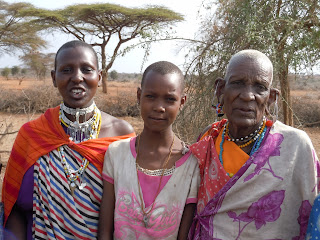
Education opportunities have changed greatly for these three generations - mother, daughter, grandmother.
Developing countries are doing what the name says - developing. When I visit Tanzania it feels like systems and structures are about 50 years behind what we enjoy in the western world. There are many examples but I am thinking of things like health care, transportation and roads, and education. We can "see" inside so much of the world today thanks to wonders like the internet and smart phones and cable television. Watching news coverage of stories in places like Africa do you sometimes find yourself asking, how can people live like that? or why don't they change? or what's wrong with them?

Well, there is nothing wrong with Africans. They are developing and changing just as other countries have. They are facing enormous challenges and can use all the help they can get from those of us who have progressed through the development phases before them.
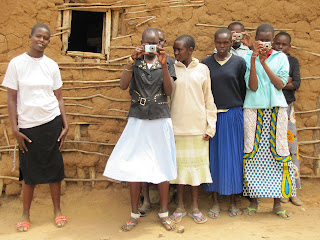
These girls thrive when given the opportunities for enriched education Canadian girls have. 
Receiving education is crucial to development and, while any education has the potential to open future possibilities for us, good quality education that provides both learning and confidence makes the greatest difference. Looking at the report cards of many students in Tanzania, some might be prompted to ask, what's wrong with these students? or why aren't they succeeding? We might falsely conclude that Tanzanians are not as smart as we are. Nothing could be farther from the truth.

The girls TEMBO sponsors are just like Canadian girls in secondary school. Except for a few differences: they live in rural villages in a country that is still developing, including the education system and teacher preparation; most of their families are economically very poor and secondary school is not free; they belong to the Maasai tribe where formal education has not been part of the culture and, if a family can send a child to school it is usually a boy; there are very few syllabus books for students to share; and all subjects taught in secondary school are taught in English - a third language the students have had very little exposure to - after speaking the Maa language at home and Swahili in primary school. I could go on about the hurdles Tanzanian girls have to face but I think you get the picture.
Mary Laiser does all the on the ground preparations in Tanzania for TEC.
Four years ago I was having a conversation during a project visit with Mary Laiser, one of the TEMBO staff  very involved in the education program. We were concerned about the failing grades of many of the girls and wanted to do something to help them succeed. We decided to offer the girls a chance to receive tutoring during their one month break in June. Mary made arrangements for the girls to be accommodated in Longido and be instructed by one of the teachers. The first week went well then the girls began skipping classes and failing the tests. We ended the program after the second week. The program was not what they needed and too much like what they got during the school year. The girls went back to school after the break and little changed.

I talked with Marian Roks, one of the TEMBO co-founders, and a life long teacher. I knew Marian had coordinated summer camps for many years for deaf students in Ottawa. These camps were both rich learning opportunities and enjoyable experiences her students looked forward to each year. Could something like this ever work in Tanzania? Why not, we concluded, since students are the same everywhere.
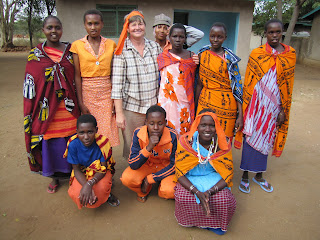
Marian Roks and some of the girls dressed in orange to celebrate
the Netherlands success in the 2010 Fifa  World Cup.
You need to know about TEC - the TEMBO English Camp - developed by Marian and Virginia Taylor. Virginia is on the Project TEMBO Board of Directors in Canada and she is also an instructor in the ESL Teacher Training Program at Carleton University in Ottawa. TEC takes place for three weeks in June, half a world away, and I am sure that, if you listen closely, you can hear and feel the joy it exudes right across the Atlantic Ocean. It's a program delivered entirely in English that we believe is really making a difference for the girls TEMBO sponsors. It's part formal instruction shaped around the girls' school curriculum; part informal instruction through activities like the camera club, or cooking, or sports and games; and a whole lot of fun that takes place through interactions and conversations with Marian, Virginia, and the growing number of Canadian volunteers taking part in TEC.
Virginia Taylor with two of the proud TEC graduates in 2010, the inaugural year.
Recently, Marian, Virginia, and I met for coffee at Bridgehead Coffee House in Ottawa to talk about the June 2012 TEC program. The lesson planning has been well under way for a number of weeks with Canadian teachers and volunteers both in university and older. We talked about exciting new ideas to incorporate into the evolving TEC program, including important suggestions from Mary and Paulina in Tanzania. This year student teachers from Mt Meru University and in Teacher Training programs will be involved. It's part of the vision TEMBO has of making this education support program sustainable. Another addition will be including 15 students from Kimokouwa and Longido Primary Schools in a "Pre-TEC" program. This will allow TEMBO to help students become comfortable at reading and speaking English before they get to secondary school.

TEC has grown to the point that it would not be possible without the involvement of so many in Canada and the time, skills, and coordination of Mary Laiser and other TEMBO staff in Tanzania. This year we are especially grateful to the Ontario Teachers' Federation for a $5000.00 donation for TEC program expenses.

The education system in Tanzania is developing. Many feel it is not happening quickly enough. In February students at Ketumbeine Secondary School - where some of TEMBO's sponsored girls attend - "rioted" in protest of the poor quality teaching they were receiving. They publicly drew attention to an important reality: it is very difficult for rural schools in Tanzania to attract well trained teachers. This is not to say there are not good teachers in the countryside - it's just that there are very few of them.

All of us believe that the girls TEMBO sponsors can and will do better academically with help we can provide. We've got a lot to share thanks to the abundant and varied education opportunities we've had. And if some girls in Tanzania can gain confidence - through an enjoyable enriched learning program - that will help them do better in the classroom, then the time and effort running the TEC program is a very good investment.

Thursday, March 15, 2012

Worlds Apart and Worlds Together

Paulina and Kokoyai in Kimokouwa.
The other day I came across this photo of Paulina, TEMBO Trust Project Coordinator, and Kokoyai, a young mother living in Kimokouwa I have known since she was 10 years old. The photo is a couple of years old - Paulina, who usually wears Western-style clothing, now has her head shaved, like Kokoyai. At a glance it's a photo of two young traditional Maasai women. If you've visited the TEMBO project area you know these women live very different lives - actually "worlds apart." Still, both play a very important part in the telling of the story of TEMBO and the work we do. I find myself thinking how these two women live "worlds together," too, each telling an important part of a larger story. It's a story about evolution, modernity, and the oh so fragile balancing act of moving forward in a world changing at lightening speed while still being true to a cultural heritage filled with richness and beauty. How will they keep it all together?

In Kimokouwa, Kokoyai is part of the Maasai people who choose to live a very traditional lifestyle. Though they cannot follow the rains to graze large herds of cattle like they once did, due to government laws restricting their movement, the people still live in mud huts, eat a simple diet, dress in colourful shukas, and observe tribal norms and customs. Kokoyai attended Kimokouwa Primary School, as mandated by the government, and she and her father opted for Kokoyai to marry when she finished Standard Seven rather than continue her education. She and her husband, Philipo, currently have two boys. According to custom, Philipo is free to have as many wives as he wants. Kokoyai  also belongs to the KWGP (Kimokouwa Women's Goat Project), coordinated by TEMBO Trust.

The power stick carried by men, now with the pen representing education.
Paulina grew up in a Maasai boma near Mt. Kilimanjaro where observing traditional customs and practices was very important for her father, too. He wanted Paulina to marry after primary school. Paulina wanted desperately to continue her education. With the help of her mother, her brother, and others Paulina succeeded in completing secondary school and earned a full scholarship to the University of Dar es Salaam. Paulina's father attended her graduation ceremony and gave her a pen and a notebook as a gift, symbolizing his wish for her to continue to study, if it was her wish. He had come a long way and was embracing change.

Over the years, I have observed striking images expressing the reality that the Maasai are struggling to hold two realities, two worlds together. The world of the 21st century is knocking at the door of the Maasai in Tanzania. It is a tenuous time filled with tremendous possibilities and wrought with danger too. There is a lot at stake. As in any culture, some practices of old need to be discontinued and left behind in order for people to move forward. Women like Paulina, because of the education they have received, have a pivotal role to play in reshaping the new world of the Maasai. Knowing how to change, what to let go of and what to keep, is best done  from within by those who understand and cherish the world of the Maasai. These strong voices must be heard over the noise and values of other societies that threaten to consume and assimilate them as they have done to other tribes and other peoples throughout time.

Receiving a cell phone message: Kokoyai's father, Paulo, is in his 80's and embracing change. 
Kokoyai and the Maasai of Kimokouwa and Longido, and throughout Tanzania, have a right to a traditional life if they so choose. Paulina, and many other educated women and men like her, are using their skills to help keep everything in balance: saying thoughtfully to the Maasai 'yes' keep this, it is good, and 'no' this practice is harmful and outdated and it must go; and to those outside who would exploit or deceive the Maasai they say 'these are our rights by law, our education has taught us so.' Those of us fortunate enough to have been allowed to play a part in this unfolding must only play a supporting role, actively enabling women like Paulina and Kokoyai to take center stage.

Wednesday, March 7, 2012

Celebrating the Girls and Women of TEMBO

The girls and women I know in Longido and Kimokouwa are some of the strongest and most resilient people I have ever met. This year, on International Women's Day, March 8, I celebrate and give thanks for their lives.

Our lives are worlds apart in many ways. Most Tanzanian women live without the conveniences and blessings I often take for granted: running water, electricity, affordable quality education, good medical care, abundant food, and so much more. It is good that I can leave the comfort of my own life and culture to live in their world when I can. It helps me to put so much in perspective. I always return home feeling so much more grateful for what I have been given simply because I have been born in Canada.
Members of the KWGP group, their husbands, and village leaders.
Since my first visit to Tanzania in July 1998, I have watched little girls grow into beautiful young women and mothers. Some have chosen to remain in their bomas as traditional Maasai; some have had no say in making decisions about their lives; others have had courageous mothers who have pleaded on their behalf that their daughters might go to school; and there is a growing number of girls who have both parents wisely including education opportunities knowing that the world is changing for the Maasai as it is for people everywhere.

And isn't the world in transition? Few on this earth are not caught up in the fast moving current of change knocking at everyone's door. The women I am thinking of today want life for their daughters to be different than it is for them and they are willing to pay a high price to make this happen. They walk miles in search of firewood and water, spend long hours selling foodstuffs under the hot African sun to earn small amounts of money, and have had their lives given value by the number of cattle their husbands have "paid" for them.

Penina with her mother, daughter, and extended family.
I laud all the girls and women in Longido and Kimokouwa who have the audacity to dream for something better then they have today. I honour the women able to make small positive changes in their homes and families as a result of their participation in the micro-business program. And I honour the girls requesting education sponsorship and working hard to daily overcome great obstacles simply to stay in school.

Future generations will reap the rewards of your hopes and dreams, hard work and quiet sacrifices. And leaders will come from among you, even in your lifetime. I know this because I know you. You are a part of a great momentum composed of so many mothers and daughters all over the world. You are not alone. Happy International Women's Day!

Some of the TEMBO sponsored girls at the TEMBO English Camp, 2011.

Thursday, March 1, 2012

Early Pregnancy and Education


The new school year began early in January and TEMBO Trust staff successfully enrolled 18 new girls in Secondary School. If I close my eyes it is so easy to see their faces even though I was not in Tanzania when they were selected. Physically the girls are very small, in so many ways still children with their whole lives ahead of them. Since they passed the mandatory Standard Seven Leaving Exam at the end of Primary School, and have qualified to receive sponsorship by TEMBO, the girls now have the opportunity to continue their education. The challenges they will face on this new journey are going to be enormous and the girls deserve all the help we can give them.
Some of the TEMBO sponsored girls.
One of the greatest challenges they will face is avoiding early pregnancy. In Tanzania, if a girl becomes pregnant she will not be admitted to Secondary School. It's an old law that many, both within and outside the education system are trying to change, including TEMBO Trust staff and trustees. To understand the difficulty the girls face you need to understand African culture and, in particular, the Maasai culture. Among the Maasai, sexual activity at a young age is seen to be normal and even welcome. This is especially so in families where parents have received little or no education.

Most of the girls TEMBO sponsors belong to the Maasai tribe that populates the northern part of the country including Longido and Kimokouwa. Like many other African tribes, the Maasai depend upon extended families to sustain their lifestyles. There is a lot of hard work to do. Multiple wives with many children and large cattle herds has been typical until recently. The new reality of continual drought is prompting many Maasai to now switch to herding goats. Nonetheless, the children participate in caring for the animals. While the young boys are with the herds the young girls are helping run the households – walking long distances each day to fetch firewood and water, caring for the young, cooking and keeping the boma tidy. Add in the reality of early death - often in the mid 40's - and it's clear that large families are a way of ensuring there is always a ready workforce.

There is an alternative to girls simply following in the footsteps of their mothers and remaining traditional Maasai. It is formal education. In fact, many women want their daughters to be educated and have lives different than theirs. More and more, Maasai men are allowing their daughters to attend secondary school. Common practice is if a girl receives sponsorship she will be allowed to go to school, and if a girl is in school she will not be given in marriage to a man. For the most part this works and girls are protected from early marriages – at least until they finish Form 4 or Grade 12. But not always.
Sponsorship includes providing everything for living at boarding school
At the beginning of January 2012, the new school year, three of the girls TEMBO has been sponsoring have been turned away from school because of pregnancy. The girls returned to their bomas to give birth. For most girls in this situation, the next step will be marriage to an older man in exchange for cattle given to the father of the girl. Guess what? These girls are not some small exception. Consider these statistics from the website The Elders:

  • Every day, it is estimated that more than 25,000 girls under the age of 18 are married. 
  • 100 million more girls – around 10 million each year – will become child brides over the next decade.
  •  In the developing world, one in three girls is married before she is 18; one in seven before she is 15.
  •  A girl under the age of 15 is five times more likely to die in childbirth than a woman in her twenties.
These numbers are staggering! They also have names and faces. If at all possible, TEMBO will look for a private school to send the girls to to continue their education. This will depend upon whether or not money is available since private school sponsorships are a much more expensive option. 
Girls are learning to speak for themselves.
There is hope for change and in the next post you will hear about small actions that are making a big difference.

Sunday, February 26, 2012

Stories About Remarkable People

In this blog space I want to share stories and photos about the colourful, hopeful, and resilient people I have met since first setting foot in Tanzania in July 1998. I want you to know about the world they live in including their challenges, hopes, and dreams, and how they overcome daily obstacles few of us would ever withstand. In particular, I want you to meet the girls and women TEMBO Trust sponsors in the Education and Micro-Business programs it runs in Longido and Kimokouwa, two villages in northern Tanzania. You will also meet the staff on the ground, the people who work day in and day out to improve life in the villages and to make TEMBO's vision a reality.

Some of the women in Kimokouwa. Mount Longido is in the background.

Longido girls fetching water after a busy day at school
Since 1998 I have made many project visits to Tanzania. I have taken thousands of photos that tell as many stories. Some I have shared in journal notes I have kept and written about in other blogs. Still, my collection of stories and of photos keeps on growing, right along with the town of Longido.

I hope you will feel free to add your comments and thoughts. You can enter your email address in the column on the right. This will ensure you are notified whenever a new entry is posted here.